

 By
By 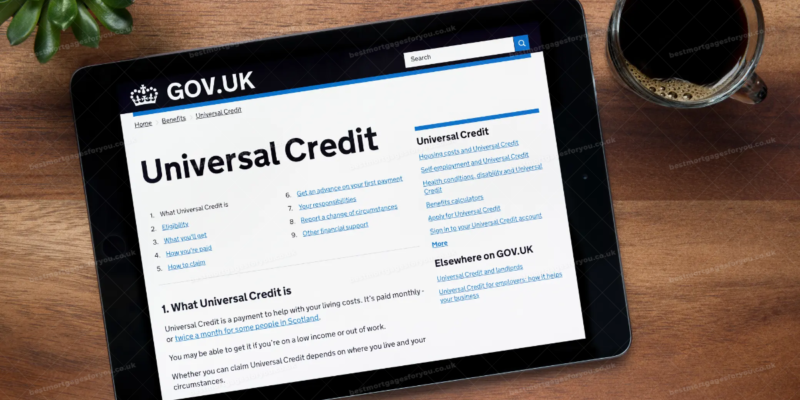
[Last Updated: 17 March 2026]
What happens when a job disappears overnight, a relationship breaks down, or earnings simply no longer cover the bills — where does someone in the UK actually turn for help?
For millions of people across the country, the answer is Universal Credit, the government’s flagship welfare payment administered by the Department for Work and Pensions (DWP). From 6 April 2026, Universal Credit undergoes its most significant overhaul in years — with above-inflation increases to the standard allowance, the removal of the controversial two-child limit, and a major reduction to the disability-related LCWRA element for new claimants, all introduced under the Universal Credit Act 2025.
Yet despite around 8.3 million people now claiming Universal Credit, the application process remains a source of confusion and anxiety for many — from savings thresholds and the five-week wait to identity verification and Jobcentre appointments. This guide on bestmortgagesforyou.co.uk walks through every stage, using the latest confirmed figures for the 2026/27 tax year, so that anyone considering a claim can approach the process with confidence rather than guesswork.
Key Takeaways
- Universal Credit can be claimed online via GOV.UK, with the full application requiring identity verification, a to-do list and a Jobcentre appointment — all within 28 days of creating an account.
- From 6 April 2026, standard allowance rates increase above inflation (by approximately 6%), the two-child limit for child elements is removed, and the LCWRA element is halved for most new claimants.
- Savings above £16,000 generally disqualify a claim, while savings between £6,000 and £16,000 reduce the payment through a tariff income calculation.
- The first Universal Credit payment arrives approximately five weeks after submitting a claim, though advance payments of up to 100% of the estimated entitlement are available and repaid over up to 24 months.
- Free support is available from the Citizens Advice Help to Claim service, MoneyHelper and the Universal Credit helpline on 0800 328 5644.
What Is Universal Credit and Who Can Claim It in 2026?
Universal Credit is a means-tested monthly payment designed to help people on a low income or out of work with their living costs. It replaced six older ‘legacy’ benefits — income-based Jobseeker’s Allowance, income-related Employment and Support Allowance, Income Support, Housing Benefit, Working Tax Credit and Child Tax Credit — under a single streamlined system.
As outlined on GOV.UK, a Universal Credit award is made up of a standard allowance (the basic amount for all eligible adults) plus additional ‘elements’ for specific circumstances such as children, housing costs, disabilities and caring responsibilities.
Eligibility Criteria at a Glance
To qualify for Universal Credit, an applicant must generally meet several core conditions. These are consistent across England, Wales, Scotland and Northern Ireland, although minor administrative differences exist in Scotland and Northern Ireland regarding payment frequency.
The table below summarises the main eligibility requirements as of March 2026.
| Requirement | Detail |
|---|---|
| Age | 18 or over (16 or 17 in limited circumstances) and under State Pension age |
| Residency | Living in the UK (England, Wales, Scotland or Northern Ireland) with the right to reside |
| Savings and capital | £16,000 or less in total savings, investments and capital (excluding the home lived in and pension pots) |
| Employment status | Unemployed, employed on a low income, or self-employed — there is no minimum or maximum hours requirement |
| Education | Not in full-time education (exceptions apply for those with children or disabilities) |
| Couples | Must make a joint claim if living with a partner — both partners’ income and capital are assessed |
Source: GOV.UK. Figures correct as of March 2026.
Worth noting — being in work does not automatically prevent a claim. Universal Credit is specifically designed to top up low earnings, with payments gradually reducing as income rises.
The £16,000 Savings Rule and How Capital Affects a Claim
One of the most frequently misunderstood aspects of Universal Credit is how savings interact with eligibility. The rules are more nuanced than many people assume.
Savings and capital of £6,000 or less have no effect on a claim whatsoever. Between £6,000 and £16,000, the DWP applies a ‘tariff income’ — £4.35 per month is assumed for every £250 (or part of £250) above the £6,000 threshold, which reduces the Universal Credit payment accordingly.
Above £16,000 in total capital, Universal Credit is generally not available. However, the home in which someone lives and any pension savings are not counted as capital — a distinction that makes a real difference for homeowners or those with workplace pensions.
Universal Credit Rates from April 2026 — What Claimants Actually Receive
A Universal Credit payment is calculated by adding together all elements a claimant is entitled to, then deducting income and any tariff income from savings. The DWP recalculates this each month based on the claimant’s circumstances during their ‘assessment period’.
Standard Allowance Rates for 2026/27
The standard allowance is the baseline payment every eligible claimant receives, regardless of whether additional elements apply. From 6 April 2026, these rates increase above inflation — by approximately 6% overall — following the provisions of the Universal Credit Act 2025.
The table below shows the confirmed monthly standard allowance rates for the 2026/27 tax year, compared with the outgoing 2025/26 rates.
| Claimant Type | 2025/26 (per month) | 2026/27 (per month) | Increase |
|---|---|---|---|
| Single, under 25 | £316.98 | £338.58 | +£21.60 |
| Single, 25 or over | £400.14 | £424.90 | +£24.76 |
| Joint claimants, both under 25 | £497.55 | £528.34 | +£30.79 |
| Joint claimants, one or both 25 or over | £628.10 | £666.97 | +£38.87 |
Source: DWP / House of Commons Library. Figures confirmed for the 2026/27 tax year, effective from 6 April 2026. Rates are subject to individual circumstances.
These above-inflation increases reflect a combined 3.8% CPI uplift plus an additional 2.3% as legislated by the Universal Credit Act 2025 — a pattern that will continue for four years through to 2029/30.
Additional Elements — Children, Housing, Disability and Caring
On top of the standard allowance, various elements can be added depending on the claimant’s household and circumstances. The following table shows the key additional element rates for 2026/27.
| Element | 2025/26 (per month) | 2026/27 (per month) |
|---|---|---|
| First child (born before 6 April 2017) | £339.00 | £351.88 |
| First child (born on or after 6 April 2017) / subsequent children | £292.81 | £303.94 |
| Disabled child addition (lower rate) | £158.76 | £164.79 |
| Disabled child addition (higher rate) | £495.87 | £514.71 |
| Limited Capability for Work (LCW) | £158.76 | £158.76 |
| LCWRA — new claimants (most) | £423.27 | £217.26 |
| LCWRA — protected / severe conditions / terminal illness | £423.27 | £429.80 |
| Carer element | £201.68 | £209.34* |
| Childcare costs (max, one child) | £1,014.63 | £1,053.18* |
| Childcare costs (max, two or more children) | £1,739.37 | £1,805.45* |
Source: DWP Benefit and Pension Rates 2026/27. Figures marked with * are estimated based on the confirmed 3.8% CPI uplift and subject to final DWP confirmation. Housing element amounts vary by area and are determined by Local Housing Allowance rates.
Bear in mind, not all elements can be received simultaneously — for instance, the carer element and the LCWRA element cannot both be included in the same individual’s award (the higher of the two applies).
Key Changes to Universal Credit from 6 April 2026
The 2026/27 tax year brings the most sweeping reforms to Universal Credit since its introduction. Three changes in particular will affect millions of claimants.
The Above-Inflation Standard Allowance Increase
Under the Universal Credit Act 2025, the standard allowance increases by approximately 6% from April 2026 — roughly 3.8% for CPI inflation plus an additional 2.3% ‘rebalancing’ uplift. According to the House of Commons Library, this above-inflation increase will continue for four consecutive years through to 2029/30, at which point the standard allowance will be 4.8% higher than it would have been under the normal CPI-only formula.
For a single claimant aged 25 or over, this translates to an extra £24.76 per month — approximately £297 more per year. The DWP describes the uplift as a permanent structural increase to tackle in-work poverty.
Removal of the Two-Child Limit
From April 2026, the two-child limit on child elements is being scrapped entirely. Previously, the child element (worth approximately £3,650 per year per child in 2026/27) was only paid for the first two children in a household born after 6 April 2017, with limited exceptions.
The government estimates that around 480,000 households will benefit from this change in 2026/27, and that 450,000 fewer children will be in relative poverty by 2030 as a direct result. Families already receiving Universal Credit should see the additional child elements applied automatically from their first assessment period on or after 6 April 2026 — no action is needed.
LCWRA Element — What Is Changing for New Claimants?
Here’s the thing — while the standard allowance is going up, the LCWRA (limited capability for work and work-related activity) element is being cut by nearly half for most people newly entitled to it from 6 April 2026. The monthly amount drops from £423.27 to £217.26 for new claimants, a reduction of over £2,400 per year.
Existing claimants who already receive the LCWRA element before 6 April 2026 are fully protected and will continue to receive the higher rate (rising to £429.80 per month). Protection also applies to those with terminal illness or those meeting the DWP’s ‘severe conditions’ criteria.
According to Citizens Advice, anyone with a health condition or disability should report it and request a health assessment as soon as possible — doing so before 6 April 2026 starts the assessment process under the higher-rate rules.
How to Apply for Universal Credit Online — Step by Step
The application process is conducted primarily online through GOV.UK, though telephone claims are available in certain circumstances. The entire process — from creating an account to receiving a first payment — typically takes around five to six weeks.
Setting Up a GOV.UK Account
The first step is to create an account on the GOV.UK Universal Credit page. An email address and phone number are needed to set up login credentials, including a username, password and two security questions.
Once the account is created, the claim must be completed and submitted within 28 days — otherwise the account resets and the process starts again. The claim start date is the date the application is formally submitted, not the date the account is created.
Completing the To-Do List and Verifying Identity
After logging in, the system presents a ‘to-do list’ — a series of questions covering personal details, housing situation, employment status, health conditions, childcare and bank account information. Every item on the list must be completed before the claim can be submitted.
Identity verification can be done online using GOV.UK Verify (with a UK passport or driving licence) or in person at the Jobcentre. Those without standard ID documents can confirm their identity by answering security questions over the phone or by having someone else verify it on their behalf.
Booking and Attending the Jobcentre Appointment
Once the claim is submitted, the DWP arranges a Jobcentre Plus appointment within 10 working days. At this meeting, a work coach checks the claimant’s details, discusses work-related requirements and agrees a ‘Claimant Commitment’ — an outline of the activities the claimant agrees to undertake in return for their Universal Credit payment.
The Claimant Commitment is tailored to individual circumstances. Someone with caring responsibilities or a serious health condition will have very different (or no) work search requirements compared to someone who is fit and available for work.
Applying as a Couple — How Joint Claims Work
Couples living together must apply jointly for Universal Credit — single claims are not permitted unless a partner is temporarily absent for more than six months, in prison or not eligible due to immigration status. Both partners need to create separate GOV.UK accounts and link them together using a code provided during the application.
Both partners’ income, savings and capital are assessed together. This is a crucial point — even if only one partner is working, the household income as a whole determines the Universal Credit amount.
Documents Needed for a Universal Credit Application
Having the right documents ready before starting the online application can significantly speed up the process. The DWP may ask for any of the following, though not all will apply to every claimant:
- Valid passport or UK driving licence (for identity verification)
- National Insurance number
- Bank, building society or credit union account details
- Proof of housing costs (tenancy agreement, rent amount, landlord details)
- Payslips or proof of earnings from the past several months
- Details of any savings, investments or capital
- Childcare provider details and costs (if applicable)
- Fit note from a GP or hospital (if claiming due to illness or disability)
- Details of other benefits currently received
- Partner’s personal and financial details (for joint claims)
Those who cannot provide all documents immediately still have up to one month after submitting the claim to supply them. The Citizens Advice Help to Claim service can assist with gathering documentation.
The Five-Week Wait — What It Means and How to Manage It
A common source of anxiety is the approximately five-week gap between submitting a Universal Credit claim and receiving the first payment. This wait exists because Universal Credit is assessed monthly — the first month after the claim date forms the initial ‘assessment period’, followed by roughly one week of processing time.
Advance Payments Explained
Anyone struggling financially during the five-week wait can request an advance payment of up to 100% of the estimated first Universal Credit entitlement. This advance is essentially a loan from the DWP, repaid through automatic deductions from future Universal Credit payments over a period of up to 24 months.
Applications for an advance can be made online via the Universal Credit account, by speaking to a work coach at the Jobcentre, or by calling the Universal Credit helpline. It is worth noting that while the advance provides immediate relief, it does reduce the amount of every subsequent payment until fully repaid.
Other Support Available During the Wait
Beyond the advance payment, several other sources of help exist for those waiting for their first Universal Credit payment:
- Council welfare assistance schemes — many local authorities offer emergency grants or vouchers for food and essentials
- Household Support Fund — distributed by local councils to help with energy bills, food and other essentials
- Food banks — referrals can be obtained through Jobcentre Plus, Citizens Advice or local charities
- Energy bill support — utility providers often have hardship funds for customers in financial difficulty
- Two-week run-on of legacy benefits — claimants moving from Housing Benefit, income-based JSA, income-related ESA or Income Support receive two additional weeks of those payments after applying for Universal Credit
According to MoneyHelper, planning ahead and understanding the timing of a claim — particularly around final wages or redundancy payments — can help minimise the financial impact of the five-week wait.
Common Myths About Claiming Universal Credit
A surprising amount of misinformation circulates on social media and forums about Universal Credit eligibility. Three myths in particular deserve correcting.
‘Working Disqualifies a Claim’ — Why That Is Not True
A common belief is that having a job automatically rules someone out of Universal Credit. In reality, Universal Credit was explicitly designed to support people on low incomes, whether employed, self-employed or out of work entirely.
There is no minimum or maximum hours requirement. Payments reduce gradually as earnings increase (via the taper rate, explained below), meaning there is no ‘cliff edge’ where accepting more hours suddenly ends all support.
‘Savings Automatically Stop Universal Credit’
Another widespread misconception is that any savings at all will prevent a claim. However, according to GOV.UK, only savings above £16,000 disqualify a claimant — and even between £6,000 and £16,000, the effect is a gradual reduction rather than a complete cut-off.
A person with exactly £10,000 in savings, for example, would have £4,000 above the £6,000 threshold. Dividing £4,000 by £250 gives 16, multiplied by £4.35 results in an assumed monthly income of £69.60 — a modest reduction rather than a disqualification.
‘Legacy Benefits Are Still Available After April 2026’
By 31 March 2026, the DWP’s managed migration of all legacy benefit claimants to Universal Credit is expected to be complete. Income-based JSA, income-related ESA, Income Support, Housing Benefit, Working Tax Credit and Child Tax Credit are no longer available for new claims, and existing claimants should have received a ‘migration notice’ instructing them to move to Universal Credit by a specified deadline.
Anyone who has not yet received a migration notice and is still claiming a legacy benefit should contact the Universal Credit helpline or speak to Citizens Advice as a matter of urgency.
How Earnings Affect Universal Credit — the Taper Rate and Work Allowances
Understanding how earnings interact with Universal Credit is essential for anyone considering work or increasing their hours. The system is designed to ensure that claimants are always better off financially by working more.
The ‘taper rate’ is currently set at 55p. This means that for every £1 earned above a claimant’s work allowance (if applicable), Universal Credit reduces by 55p — leaving the claimant 45p better off for each additional pound earned.
Work allowances are the amount someone can earn before the taper rate kicks in. They apply only to claimants who have a dependent child or who have been assessed as having limited capability for work.
| Work Allowance Type | 2025/26 (per month) | 2026/27 (per month) |
|---|---|---|
| Higher rate (no housing element claimed) | £684.00 | £710.00 |
| Lower rate (housing element claimed) | £411.00 | £427.00 |
Source: DWP / House of Commons Library. Figures confirmed for the 2026/27 tax year. Subject to individual circumstances.
Put simply, a single parent aged 30 with one child, receiving the housing element and earning £1,000 per month, would have £573 of earnings above the £427 work allowance. At the 55p taper rate, Universal Credit would reduce by £315.15 — not by the full £1,000. The remaining Universal Credit payment still provides significant support alongside earned income.
The Benefit Cap — Does It Still Apply in 2026/27?
Yes, the benefit cap remains in place for 2026/27 and — crucially — has been frozen at its current levels despite benefits increasing. This means that some households, particularly larger families, may find the full effect of the two-child limit removal offset by the cap.
| Household Type | Outside Greater London (per year) | Greater London (per year) |
|---|---|---|
| Couples and single parents | £22,020 | £25,323 |
| Single adults without children | £14,753 | £16,967 |
Source: DWP. Benefit cap amounts are frozen for 2026/27 at 2023/24 levels.
Exemptions from the benefit cap apply to households where someone receives the carer element, Carer’s Allowance, the LCWRA element, Personal Independence Payment, Disability Living Allowance or certain other disability and war-related benefits. Claimants who have recently stopped work may also qualify for a nine-month grace period.
What to Do If a Claim Is Refused — Mandatory Reconsideration
A Universal Credit claim can be refused or an entitlement decision can seem incorrect. In such cases, the first step is to request a ‘mandatory reconsideration’ — a formal review of the decision by a different DWP decision-maker.
The request must be made within one month of the date on the decision letter, either through the Universal Credit journal, by calling the helpline or by writing to the DWP. The claimant should clearly explain why the decision is believed to be wrong and provide any supporting evidence.
If the mandatory reconsideration does not resolve the issue, the next step is to appeal to an independent tribunal through HM Courts and Tribunals Service. Free advice on the appeals process is available from Citizens Advice and other welfare rights organisations.
Avoiding Universal Credit Scams — How to Stay Safe
Scammers frequently target benefit claimants through fraudulent texts, emails and phone calls claiming to be from the DWP. It is worth being vigilant — the DWP will never ask for bank details, passwords or personal information via text, email or social media.
All genuine DWP communications appear through the Universal Credit journal within the claimant’s online account. If something seems suspicious, the safest action is to log in to the GOV.UK account directly and check the journal — not to click any links in messages.
Anyone who believes they have been targeted by a scam should report it to Action Fraud on 0300 123 2040 or via actionfraud.police.uk. Suspected benefit fraud can be reported to the DWP’s National Benefit Fraud Hotline on 0800 854 440.
Key Contact Details
| Organisation | Contact |
|---|---|
| Universal Credit helpline | 0800 328 5644 (Mon–Fri, 8am–6pm, free) |
| Universal Credit helpline (Welsh) | 0800 328 1744 |
| Relay UK | 18001 then 0800 328 5644 |
| Citizens Advice Help to Claim | 0800 144 8 444 (England) / 0800 024 1220 (Wales) |
| Action Fraud | 0300 123 2040 |
| DWP Benefit Fraud Hotline | 0800 854 440 |
Where to Get Free Help With a Universal Credit Claim
Navigating the Universal Credit system does not have to be done alone. Several free, independent services exist specifically to support claimants through the application process and beyond.
The Citizens Advice Help to Claim service provides free, confidential support from trained advisers who can help with everything from the initial online application to preparing for a Jobcentre appointment. This service is available by phone, online chat and in person.
MoneyHelper — backed by the Money and Pensions Service — offers step-by-step guides, a benefits calculator and practical advice on managing money during the five-week wait. Local councils, housing associations and charities such as Turn2us, Shelter and Scope also provide specialised support for claimants in specific circumstances.
For a broader look at how the latest benefit changes interact with household finances, readers may also find it helpful to explore guides on understanding Universal Credit changes in 2026 and the five-week wait explained for more detailed breakdowns.
The information on bestmortgagesforyou.co.uk is for general informational purposes only and does not constitute financial advice. Universal Credit rates, eligibility criteria and government policies change frequently. Always consult a qualified adviser — such as Citizens Advice, MoneyHelper or the Universal Credit helpline — before making decisions about benefits claims. This site is not affiliated with the DWP, HMRC, the FCA, the Bank of England, or any government department.
The Universal Credit system is not always straightforward, but the support available in 2026 is more generous — and more accessible — than many people realise. Taking the time to prepare documents, understand the timeline and use the free help available can make a genuine difference to the experience of claiming.
Whether the situation involves a sudden job loss, a change in family circumstances or simply earnings that no longer stretch far enough, Universal Credit exists as a safety net — and knowing how to access it properly is the first step toward making the most of that support.
Sources
- GOV.UK — Apply for Universal Credit
- GOV.UK — How to Claim Universal Credit
- Citizens Advice — How Universal Credit Is Changing in 2026
- House of Commons Library — Changes to Universal Credit Rates from April 2026
- House of Commons Library — Benefits Uprating 2026/27
- MoneyHelper — How to Apply for Universal Credit
Frequently Asked Questions

Senior financial practitioner with over 25 years' experience in banking and MSME consultancy in Lampung. Currently serving as Deputy Editor-in-Chief, delivering banking, business economics, and financial literacy content that is warm, accurate, and accessible to all.
Judul Pekerjaan: Deputy Editor-in-Chief & Senior Financial Literacy Writer



Comments